Potassium hydroxide is an inorganic compound with the formula KOH, and is commonly called caustic potash.
Along with sodium hydroxide (NaOH), this colorless solid is a prototypical strong base. It has many industrial and niche applications, most of which exploit its corrosive nature and its reactivity toward acids. About 100 times more NaOH than KOH is produced annually. KOH is noteworthy as the precursor to most soft and liquid soaps, as well as numerous potassium-containing chemicals. It is a white, solid that is dangerously corrosive. Most commercial samples are ca. 90% pure, the remainder being water and carbonates.
Potassium hydroxide is usually sold as translucent pellets, which become tacky in air because KOH is hygroscopic. Consequently, KOH typically contains varying amounts of water (as well as carbonates - see below). Its dissolution in water is strongly exothermic. Concentrated aqueous solutions are sometimes called potassium lyes. Even at high temperatures, solid KOH does not dehydrate readily.
Like NaOH, KOH exhibits high thermal stability. The gaseous species is dimeric. Because of its high stability and relatively low melting point, it is often melt-cast as pellets or rods, forms that have low surface area and convenient handling properties.
Two types of Potassium Hydroxide:
Manufacture :
 Historically, KOH was made by adding potassium carbonate to a strong solution of calcium hydroxide (slaked lime) The salt metathesis reaction results in precipitation of solid calcium carbonate, leaving potassium hydroxide in solution

2 KCl + 2 H2O → 2 KOH + Cl2 + H2
Ca(OH)2 + K2CO3 → CaCO3 + 2 KOH
Filtering off the precipitated calcium carbonate and boiling down the solution gives potassium hydroxide. This method of producing potassium hydroxide remained dominant until the late 19th century, when it was largely replaced by the current method of electrolysis of potassium chloride solutions. The method is analogous to the manufacture of sodium hydroxide (see chloralkali process):
Hydrogen gas forms as a byproduct on the cathode; concurrently, an anodic oxidation of the chloride ion takes place, forming chlorine gas as a byproduct. Separation of the anodic and cathodic spaces in the electrolysis cell is essential for this process.
Uses :
KOH and NaOH can be used interchangeably for a number of applications, although in industry, NaOH is preferred because of its lower cost.
Precursor to other potassium compounds
Many potassium salts are prepared by neutralization reactions involving KOH. The potassium salts of carbonate, cyanide, permanganate, phosphate, and various silicates are prepared by treating either the oxides or the acids with KOH. The high solubility of potassium phosphate is desirable in fertilizers.
Manufacture of soft soaps
The saponification of fats with KOH is used to prepare the corresponding "potassium soaps", which are softer than the more common sodium hydroxide-derived soaps. Because of their softness and greater solubility, potassium soaps require less water to liquefy, and can thus contain more cleaning agent than liquefied sodium soaps.
As an electrolyte
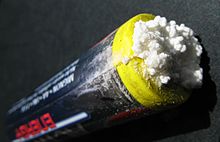 Aqueous potassium hydroxide is employed as the electrolyte in alkaline batteries based on nickel-cadmium, nickel-hydrogen, and manganese dioxide-zinc. Potassium hydroxide is preferred over sodium hydroxide because its solutions are more conductive. The nickel–metal hydride batteries in the Toyota Prius use a mixture of potassium hydroxide and sodium hydroxide. Nickel–iron batteries also use potassium hydroxide electrolyte.


